Which walk-in cooler layout makes inventory counts faster and more accurate?
A count follows the shelves. If the shelves are organized for counting, the count takes far less time and the numbers hold up. Here is a layout that works in most kitchens.
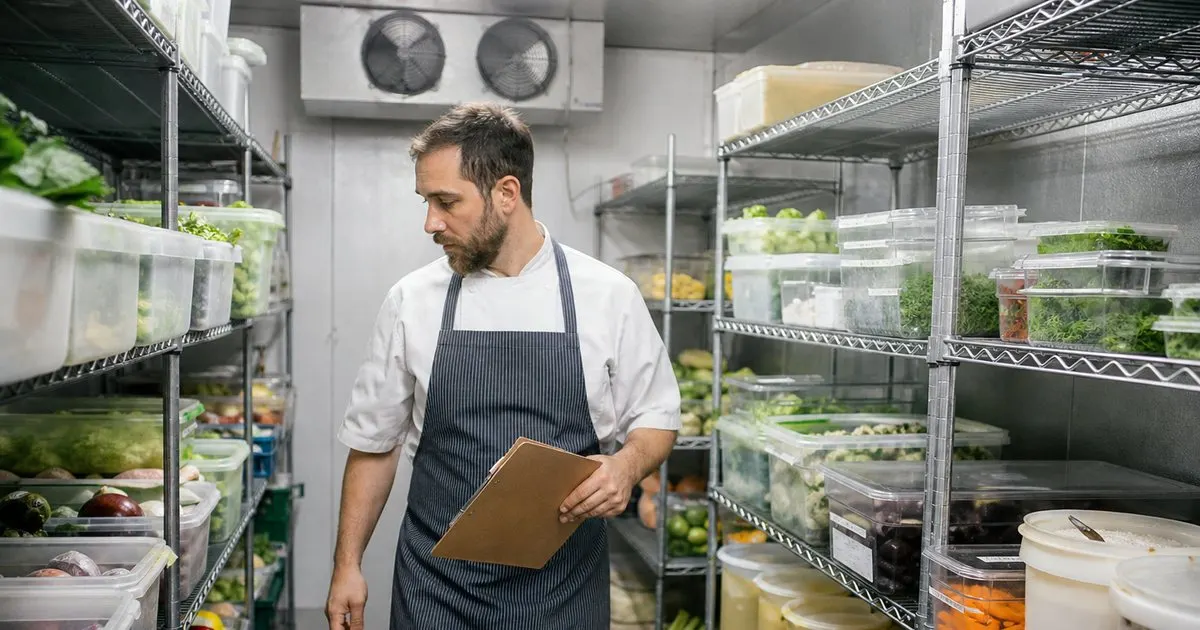
Why layout decides how long a count takes
Watch someone count a disorganized walk-in and you will see the problem. They find a case of one item on the bottom shelf, another on the top, and a third behind the milk. They walk the same aisle three times. They skip the line on the count sheet because they cannot find the product, then come back to it. Every extra pass adds time and adds a chance of double counting or missing a case. A walk-in laid out so that each item lives in exactly one spot, in the order the count sheet lists them, removes most of that. Related: How do reorder alerts prevent stockouts before they hit the line?
Accuracy improves for the same reason. When items have a home, a missing case is visible as an empty space, not just a lower number. When like items are together, a mislabeled container stands out. And when the count follows a fixed path, the counter is less likely to lose their place. The layout is doing part of the counting work before anyone picks up the sheet. Related: What is the fastest way to run accurate weekly inventory counts in a kitchen?
Keep reading: How do you set par levels for restaurant inventory that actually hold up?, What is the fastest way to run accurate weekly inventory counts in a kitchen?, How do reorder alerts prevent stockouts before they hit the line?. See how ParLevelr helps you restaurant inventory par levels and reorder alerts.
A layout that works: zones by category, then by frequency
Divide the walk-in into zones by category: raw proteins on the lowest shelves for food safety and because they are heavy, dairy together, produce together, prepared and par-cooked items together, and sauces and open containers on their own shelf. Within each zone, put the fastest moving items at the most accessible height and the slow movers higher or deeper. This matches how cooks pull product during service and it matches how a count naturally flows, zone by zone, from one end of the box to the other.
Then match the count sheet to the layout. The sheet, whether paper or an app, should list items in the exact order they appear as you walk the box, starting at the door and moving in one direction. If you use software that lets you assign items to storage locations and sort by them, this is what that feature is for. If you are on paper, reprint the sheet in shelf order and keep it that way, updating it when the layout changes rather than letting the two drift apart.
Labels, bins, and the one-spot rule
Every shelf position gets a label with the item name and counting unit. Every open or portioned container gets a label with contents and date. This sounds tedious and it takes an afternoon to set up, but it removes the guessing that slows counts down. Clear bins for loose items, such as portioned proteins or bagged produce, let a counter see quantity without opening anything. Sealed cases stay in their cases and are counted as cases, with the open case in front.
The one-spot rule is the hard part to enforce: each item has exactly one home, and overflow goes in a marked overflow area, not wherever there is space. During a big delivery it is tempting to stack cases wherever they fit, and that is exactly when items disappear from counts. If overflow is routine for some items, the shelf allocation is wrong and the item needs more space, or the par is too high and you are storing more than you use.
Keeping it organized when the kitchen is busy
A layout only helps if it survives the week. Two habits keep it intact. First, put-away is part of receiving: whoever checks in the delivery also puts it in its home, oldest stock forward, rather than leaving cases on the floor for someone else. Second, a two minute end-of-shift walk through the walk-in to move anything that has wandered back to its spot, usually done by the closing lead. These are small tasks, but they are the difference between a layout that lasts and one that lasts until Friday. Related: How do you check in deliveries so inventory counts stay honest all week?
Reassess the layout when the menu changes or when counts start taking longer again. Items that are no longer used should leave the box, new items need a home, and pars that changed may need more or less shelf space. A tidy, fixed layout with a count sheet that matches it turns a count from a search into a steady walk, and the numbers it produces are ones you can actually order from. Related: When should a restaurant adjust par levels ahead of a seasonal menu change?
- Give every item exactly one home in the walk-in and count in shelf order from the door.
- Zone by category, then place fast movers at the most accessible height within each zone.
- Label every shelf position with the item and counting unit, and every container with contents and date.
- Make put-away part of receiving and do a short end-of-shift reset so the layout holds.

Julien Jimenez
Julien Jimenez is an independent software builder based in Paris. He designs, ships, and operates focused SaaS products for small businesses and independent professionals. Read the full author page.
Never Run Out And Never Over Order
Restaurant inventory par levels and reorder alerts. ParLevelr is built to help you put this into practice.
Start free trialMore from the ParLevelr blog
How do you set par levels for restaurant inventory that actually hold up?

What is the fastest way to run accurate weekly inventory counts in a kitchen?
How do reorder alerts prevent stockouts before they hit the line?
Get the ParLevelr playbook
Practical guides on inventory and ordering, straight to your inbox as we publish them. No spam, unsubscribe any time.