Why do to-go packaging and cleaning supplies need par levels just as much as food?
Non-food supplies stop service as fast as a missing protein, but they usually have no owner and no reorder trigger. Here is how to put real pars on packaging, paper and chemicals.
Supplies fail quietly until they fail loudly
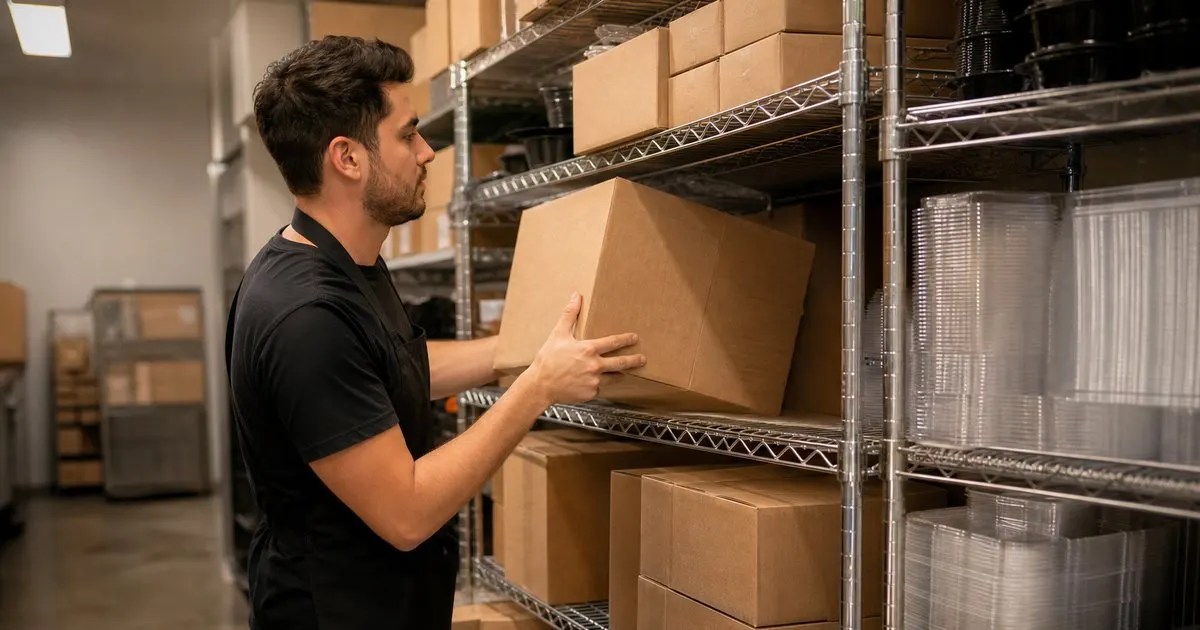
Nobody puts takeout containers on the food cost line, so they rarely get the attention a protein does. They still stop service. A kitchen that runs out of the large round containers on a busy delivery night starts improvising with the wrong size, which loses product on every order and looks careless to the guest opening the bag. Run out of the right sanitizer concentrate and you no longer have an inconvenience, you have a compliance problem in the middle of a shift. Related: How do reorder alerts prevent stockouts before they hit the line?
The failure pattern is almost always identical. Supplies live in a back room or a basement that nobody counts, there is no single owner, and the reorder trigger is a person noticing an empty spot on a shelf. That works until the person who notices takes a week off, or until a promotion doubles off premise volume without warning. Supply orders also tend to come from a different vendor on a different delivery day than food, so the recovery time when you miss is usually longer, not shorter. Related: How can better inventory control cut food waste without risking stockouts?
Keep reading: How do you set par levels for restaurant inventory that actually hold up?, What is the fastest way to run accurate weekly inventory counts in a kitchen?, How do reorder alerts prevent stockouts before they hit the line?. See how ParLevelr helps you restaurant inventory par levels and reorder alerts.
Tie each supply family to the driver that actually moves it
Food pars key off covers. Supply pars often do not. Containers, bags and cutlery track the number of off premise orders and the channel mix rather than total guests. Paper towels and gloves track labor hours and the number of stations open. Warewashing chemicals track machine cycles and rack counts. Liners and filters track a fixed maintenance schedule. Pick the driver for each family, write it next to the item, and you will know exactly which number to multiply the next time volume shifts.
Once you have the driver, measure usage per unit of it instead of guessing. The simplest method is a short measured window: count a category carefully, run two normal weeks, count again, then divide the difference by the driver for those weeks. That gives you containers per delivery order or gloves per labor hour with almost no effort. Do it once per category and revisit only when something structural changes, such as adding a delivery channel or switching to a different glove or cup.
Case packs and shelf space set the real par, not the arithmetic
Supply math produces fractional answers that no vendor will sell you. Cases come in fixed packs, some items carry minimum order quantities, and free freight thresholds tempt people into over ordering. Set the par in whole cases, at the smallest count that covers demand through the next delivery plus a buffer for a bad week, and keep the reorder point below it. Inflating the par so the truck arrives free is a decision to store cash on a shelf, and it should be made deliberately if at all.
The other hard limit is cube. A case of large containers eats far more shelf than a case of straws worth the same money, so storage, not cash, is often the binding constraint. Walk the storage area and assign every item a physical home and a maximum stack height. When the assigned space cannot hold the par you calculated, the honest answer is to order more often, not to stack cases in a hallway where they get crushed, soiled or simply forgotten until someone reorders on top of them.
Count supplies on a slower cadence, but count them
Supplies do not need the weekly count that food gets. Most operators do well counting the full supply list once a month for value and spot counting the fast movers weekly, usually the top container sizes, gloves and whatever chemical the dish machine drinks. Attach that spot count to the end of the food count walk so it never becomes a separate errand competing for time nobody has. The habit matters far more than the precision on slow moving items. Related: What is the fastest way to run accurate weekly inventory counts in a kitchen?
Then watch two signals over the following months. Chronic early triggers, where you hit the reorder point sooner than the par predicted, mean the par is short or the driver has changed. Items wearing dust are dead stock, usually left over from a packaging change or a menu item that got cut, and they are worth clearing because they hold the shelf space your live pars need. A brief quarterly pass through the supply list keeps it from turning into an archive of decisions nobody remembers making. Related: How do you set par levels for restaurant inventory that actually hold up?
- Supplies stop service as surely as food does, and they fail because no one owns them and nothing triggers the order.
- Key each family to its real driver, off premise orders, labor hours or machine cycles, rather than to total covers.
- Set pars in whole cases and respect shelf cube, since case pack and storage usually bind before cash does.
- Count the full supply list monthly, spot count fast movers weekly, and clear dead stock once a quarter.

Julien Jimenez
Julien Jimenez is an independent software builder based in Paris. He designs, ships, and operates focused SaaS products for small businesses and independent professionals. Read the full author page.
Never Run Out And Never Over Order
Restaurant inventory par levels and reorder alerts. ParLevelr is built to help you put this into practice.
Start free trialMore from the ParLevelr blog
How do you set par levels for restaurant inventory that actually hold up?
What is the fastest way to run accurate weekly inventory counts in a kitchen?
How do reorder alerts prevent stockouts before they hit the line?
Get the ParLevelr playbook
Practical guides on inventory and ordering, straight to your inbox as we publish them. No spam, unsubscribe any time.